How AI Is Transforming Global Hiring in 2026—and How Deel Connects Recruiting, Compliance, and Payroll
AI is changing the way companies hire.
In 2026, businesses can use AI to generate job descriptions, support sourcing, screen and organize candidate information, summarize interviews, improve workforce planning, and reduce the manual work that slows down recruiters and hiring managers.
But there is a much bigger transformation happening beyond recruiting.
As AI makes it easier for companies to find talent anywhere in the world, businesses are increasingly facing a new challenge:
How do you turn a global hiring decision into a compliant, operational workforce?
Finding a great software engineer in Germany, a sales leader in Singapore, or a designer in Brazil is only the beginning.
The company still needs to decide how to hire that person, onboard them, manage employment or contractor requirements, process payroll, handle local taxes and benefits, and stay on top of changing regulations.
This is where Deel becomes more than just a payroll or Employer of Record platform.
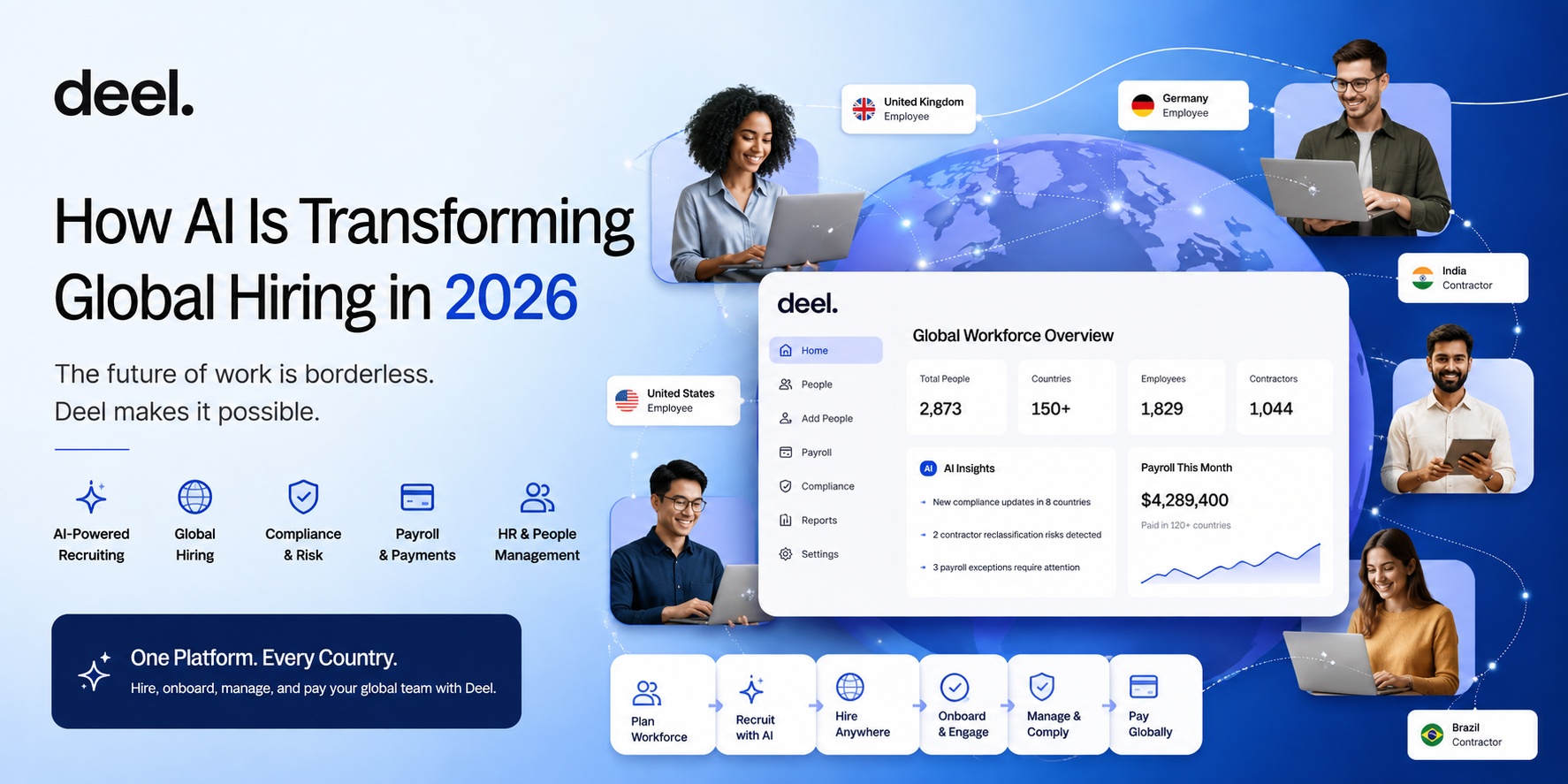
Deel is building a connected global workforce platform that brings together AI-powered recruiting, workforce planning, onboarding, HR, global employment, contractor management, compliance, and payroll.
The result is a more connected model for global hiring:
Plan → Recruit → Hire → Onboard → Employ → Manage → Pay → Monitor compliance
And increasingly, AI is helping make each stage faster and more intelligent.
The Biggest Problem With Traditional Global Hiring
Traditionally, hiring someone internationally could require a collection of disconnected tools and providers.
A company might use:
- One platform for recruiting
- Another system for HR
- Local lawyers for employment questions
- Separate providers for contracts
- Multiple payroll vendors
- Spreadsheets for headcount planning
- Manual processes to monitor compliance
The candidate experience might begin in one system and then disappear into a series of manual handoffs.
Recruiters finish their work.
Then HR takes over.
Then legal becomes involved.
Then payroll needs the employee information.
Then finance needs to understand the total employment cost.
Every handoff creates friction.
Every manual transfer of data can create delays or errors.
Deel’s approach is to connect these stages into a single workforce ecosystem.
Its current product stack covers hiring, ATS, Employer of Record services, contractor management, HR, payroll, compliance, benefits, mobility, IT and workforce planning.
This is important because AI is most powerful when it is connected to the actual workflow—not operating as a separate tool that creates yet another handoff.
Deel Is Bringing AI Into the Beginning of the Hiring Journey
One of the most significant developments is Deel.com ATS, Deel’s AI-powered applicant tracking system.
Instead of treating recruiting as a completely separate system, Deel connects workforce planning, recruiting, offers, onboarding, HR and payroll within its broader platform.
According to Deel, its ATS can help teams:
- Plan and approve headcount
- Create job requisitions
- Source candidates
- Use AI to support candidate screening and matching
- Manage interviews
- Generate interview summaries
- Extend offers
- Move new hires into onboarding
The important advantage is the connection between stages.
Candidate-to-hire information can move from workforce planning through the ATS and into onboarding without requiring teams to manually recreate employee records.
That changes the traditional hiring workflow.
Instead of this:
Recruiting platform → spreadsheet → HR system → contract provider → payroll vendor
The goal becomes a connected process within Deel.
AI helps reduce the busywork
AI is particularly useful when hiring teams are dealing with repetitive administrative tasks.
Deel’s global hiring workflow includes AI assistance for activities such as generating job descriptions, screening applicants, surfacing relevant candidates and supporting hiring workflows.
This allows recruiters and hiring managers to spend more time on the work AI should not replace:
- Evaluating experience
- Assessing skills
- Conducting meaningful interviews
- Building relationships with candidates
- Making final hiring decisions
Importantly, Deel states that its AI-assisted candidate matching is designed to support hiring teams, while final decisions remain with human reviewers.
That distinction is critical.
AI can accelerate the workflow, but hiring still requires human accountability.
From “We Found the Candidate” to “How Do We Hire Them?”
This is where global hiring becomes significantly more complex.
Imagine your company has found the perfect candidate.
The problem is that the candidate lives in a country where your business does not have a legal entity.
Traditionally, the company may have faced difficult choices:
- Open a local entity
- Find a local provider
- Attempt to engage the person as a contractor
- Delay the hiring process
- Decide not to hire the candidate
Deel provides additional options.
Hire Employees Globally With Deel EOR
Deel’s Employer of Record solution allows businesses to hire employees in countries where they do not have their own local entity.
Deel states that its EOR infrastructure supports hiring and employment operations across more than 150 countries, while its owned entities and payroll infrastructure operate across a large global footprint.
The broader value is speed and operational simplicity.
Instead of building a legal infrastructure before hiring talent, companies can use an EOR model where appropriate.
Deel supports areas across the employment lifecycle, including:
- Employment setup
- Localized contracts
- Onboarding
- Payroll
- Taxes and statutory requirements
- Benefits
- HR administration
- Ongoing employment compliance
This means that the AI-powered recruiting workflow does not have to stop once the company chooses a candidate.
The hiring decision can move into a global employment workflow.
Find the candidate with Deel → manage the recruiting process → extend the offer → transition into onboarding → employ through the appropriate Deel solution → manage payroll and HR.
That continuity is one of the most important ideas behind the modern global hiring stack.
What If the Worker Is a Contractor?
Not every global worker is an employee.
Many companies work with international contractors, consultants and freelancers.
But contractor management can create its own operational and compliance challenges.
A company may need to consider:
- Local contract requirements
- Worker classification
- Payment methods
- Currency
- Tax considerations
- Ongoing documentation
- Changes in the working relationship
Deel provides contractor management tools designed to bring these workflows into one platform.
According to Deel, businesses can create localized contracts, manage contractor onboarding, centralize documentation and make global payments across countries and jurisdictions. Deel also includes classification safeguards designed to help identify potential worker classification risks.
This becomes increasingly relevant in the AI era.
As AI makes it easier for companies to discover and engage talent around the world, the number of different worker relationships a company manages can increase.
A business may simultaneously have:
- Employees hired through its own entities
- International employees hired through an EOR
- Independent contractors
- Freelancers
- Consultants
Managing all of those relationships through disconnected systems can quickly become complicated.
Deel’s platform is designed to provide a more unified view of those global workforce relationships.
Deel AI: Bringing AI Beyond Recruiting
The AI story does not stop with Deel ATS.
Deel also offers Deel AI, which is integrated across its products and designed to provide HR, compliance and workforce insights.
Deel describes its AI as being informed by HR and compliance expertise across more than 150 countries and integrated with an organization’s people data to provide more contextual answers and insights.
For a global company, this could help teams get faster answers to questions such as:
- What are the relevant employment requirements in a particular country?
- What information do we have about our global workforce?
- Where could there be potential compliance concerns?
- What changes may affect a team or employment arrangement?
This is a major shift from the traditional approach.
Previously, a manager might need to search through internal documents, contact HR, ask a legal team or research local requirements manually.
AI can reduce the time required to find and understand relevant information.
However, AI should be treated as an assistance layer—not as a substitute for professional judgment in complex legal or employment matters.
AI Is Making Compliance More Proactive
One of the most interesting parts of Deel’s strategy is the use of technology to move compliance from a reactive process toward a more continuous workflow.
Traditional compliance processes are often reactive.
A regulation changes.
Someone discovers it.
The team determines which employees or contractors are affected.
Then the business manually updates its processes.
For a company operating across many countries, that can become extremely difficult to manage.
Deel’s compliance infrastructure is designed around several capabilities, including:
Monitoring regulatory changes
Deel tracks changes such as employment requirements, wage rules and tax updates.
Comparing worker information against local requirements
Worker information can be evaluated against country-specific rules across areas such as employment status, contracts and payroll.
Flagging potential risks
The platform can surface issues that may require attention before they become larger operational problems.
Supporting worker classification decisions
Deel also offers an AI-powered Worker Classifier designed to assess potential classification risk using localized models.
This is particularly important because the speed created by AI can also create new risks.
If a company can identify and engage talent across five new countries in a matter of weeks, its compliance infrastructure needs to keep up.
AI-powered growth without operational controls can simply create problems faster.
The opportunity is to combine AI-driven speed with global compliance infrastructure.
AI-Powered Hiring Needs AI-Powered Payroll
Payroll is another part of the employee lifecycle where AI is beginning to have a greater impact.
Global payroll can involve:
- Multiple countries
- Different currencies
- Local tax requirements
- Statutory deductions
- Different payroll calendars
- Employee changes
- Expenses
- Benefits
- Regulatory updates
Managing this through multiple local vendors and disconnected spreadsheets can make it difficult to maintain visibility.
Deel provides a centralized global payroll platform designed to bring employees, contractors, EOR workers and other payroll data into a connected system.
The platform applies local payroll rules and compliance requirements as part of the workflow.
Deel is also expanding its AI capabilities in payroll.
Its recent AI-focused payroll strategy emphasizes using AI inside payroll workflows to identify potential issues and help teams move from simply receiving answers to taking action within operational processes.
The practical idea is not:
Instead, the more realistic model is:
That is particularly valuable for global organizations.
One Connected Workflow: The Real Value of Deel
The strongest reason Deel fits into the AI transformation of global hiring is not just one individual feature.
It is the ability to connect multiple stages of the workforce lifecycle.
Consider this example.
A fast-growing technology company needs to hire AI engineers, product managers and sales professionals across multiple countries.
Step 1: Plan
The company uses workforce planning to understand:
- Which roles are required
- Where they can be hired
- Expected costs
- Headcount requirements
Step 2: Recruit with Deel ATS
The roles move into Deel’s recruiting workflow.
The hiring team selects the best candidate.
The company can use AI-powered capabilities to help with job descriptions, candidate matching, screening and interview workflows.
Step 3: Make the hiring decision
Human reviewers remain responsible for the final decision.
Step 4: Choose the appropriate hiring model
The company determines whether the person should be:
- Hired directly through an existing entity
- Hired through Deel EOR
- Engaged as a contractor
Step 5: Onboard
The new worker moves into onboarding.
Relevant information, documents and employment requirements can be managed through the connected workflow.
Step 6: Manage HR and the workforce
The company manages people data, time off, policies and workforce information.
Step 7: Pay the worker
Depending on the worker’s arrangement, Deel can support global payroll, EOR payroll or contractor payments.
Step 8: Monitor compliance
Deel’s compliance capabilities help businesses monitor regulatory changes and identify potential issues across the workforce.
This is what makes the platform relevant to the broader AI transformation.
AI helps accelerate the decision-making and administrative work. Deel provides the connected infrastructure to operationalize the result.
Why This Matters for Companies Hiring Globally in 2026
The global talent market is becoming more accessible.
AI is reducing many of the barriers involved in:
- Creating roles
- Finding candidates
- Processing applications
- Managing interviews
- Organizing information
- Moving candidates through hiring workflows
But international hiring still involves real-world complexity.
A company cannot simply use AI to identify a candidate and assume the operational work is complete.
Someone still needs to address:
- Employment structure
- Worker classification
- Local contracts
- Payroll
- Taxes
- Benefits
- Employment regulations
- Data and documentation
- Regulatory changes
This is where Deel’s broader infrastructure becomes important.
Deel combines capabilities across:
AI-powered recruiting + global hiring + Employer of Record + contractor management + HR + compliance + payroll.
Instead of viewing each of these as an isolated process, Deel is positioning them as connected parts of the global workforce lifecycle.
The Future of Global Hiring Is AI + Infrastructure
AI alone will not solve global hiring.
It can make companies dramatically faster at finding, evaluating and moving candidates through the recruitment process.
But the moment a company decides to hire someone internationally, infrastructure matters.
The company needs a way to answer:
How do we hire this person?
How do we onboard them?
How do we classify the working relationship appropriately?
How do we pay them?
How do we manage their employment across borders?
How do we stay informed about changing regulations?
This is where Deel provides the infrastructure layer behind the AI-powered hiring workflow.
Deel’s AI-powered ATS can help move candidates from recruiting toward onboarding.
Deel EOR can support companies hiring employees internationally without first establishing their own local entity.
Deel’s contractor solutions can help businesses onboard, manage and pay global contractors.
Deel HR can centralize workforce information and connect HR workflows.
Deel Payroll can bring global payroll operations into a more unified system.
And Deel’s compliance tools and AI-powered capabilities can help companies monitor changes and identify potential workforce risks.
Final Thoughts: AI Can Help You Find Talent. Deel Helps You Put Global Hiring Into Action.
The AI transformation of hiring is not only about generating better job descriptions or screening candidates faster.
The real transformation is happening across the entire employee lifecycle.
In 2026, companies increasingly need technology that can connect:
Workforce planning → Recruiting → Hiring → Onboarding → Global employment → HR → Compliance → Payroll
That is where Deel has an opportunity to become a central part of the modern global hiring stack.
AI can help companies discover the best person for a role—regardless of where that person lives.
Deel can help businesses take the next step: hiring, onboarding, managing and paying that global workforce through connected infrastructure.
As companies become increasingly borderless, the winners will not simply be the businesses that find talent faster.
They will be the businesses that can turn global hiring decisions into scalable, connected and operational workforce systems.
And in that future, AI may be the intelligence layer—but Deel is designed to be the infrastructure that helps global work actually happen.
Learn more about Deel and explore its global hiring, HR, compliance and payroll solutions.
Disclaimer: This article is for informational purposes only and does not constitute legal, tax, or employment advice. Businesses should obtain appropriate professional advice for their specific employment and compliance circumstances.